 OrthoTruss™
OrthoTruss™
OrthoTruss™
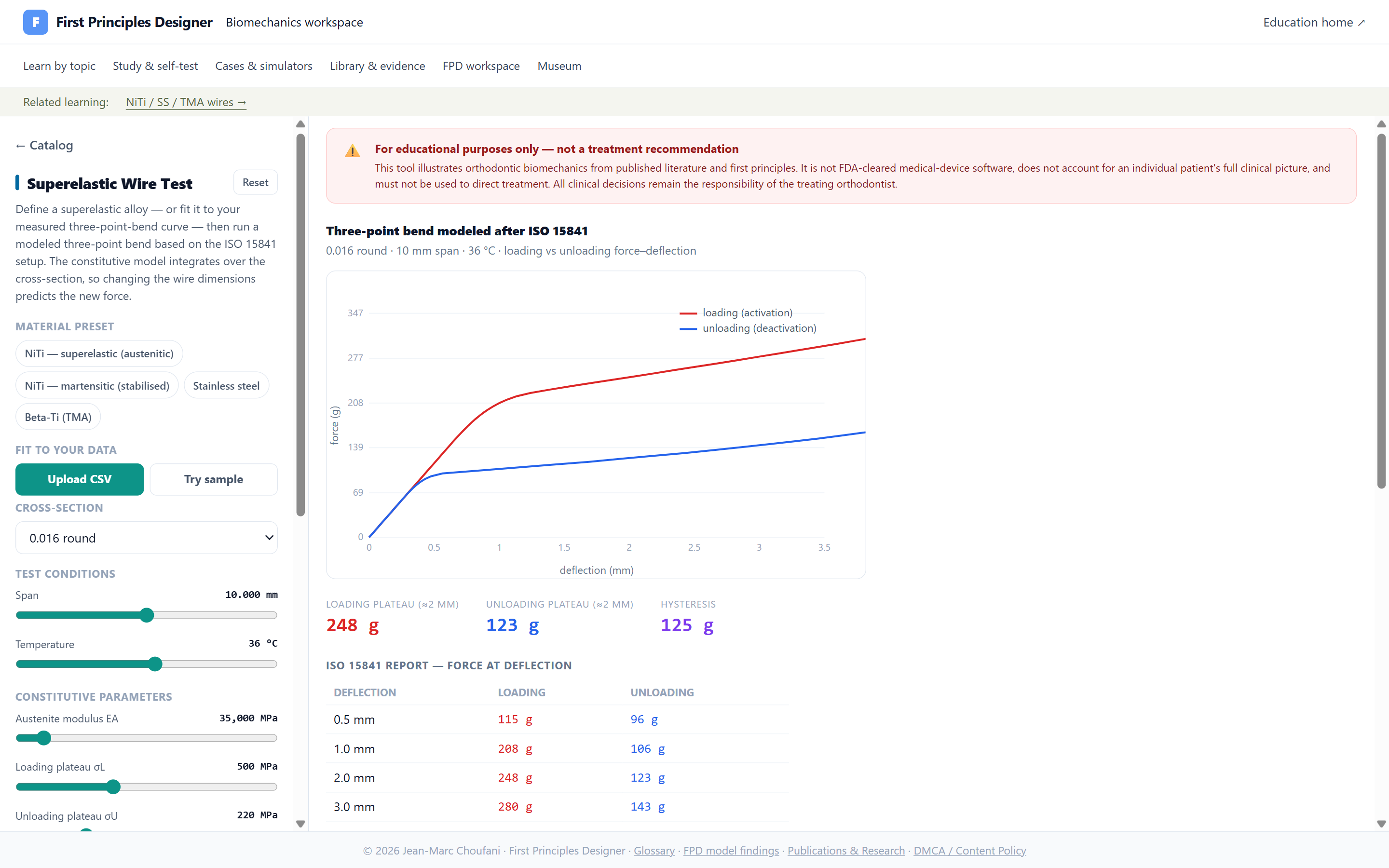
For archwire research: define a superelastic alloy (or fit it to a measured three-point-bend curve), run a software test modeled after ISO 15841, and inspect the resulting mechanical force system. The virtual protocol supports exploration; it does not certify conformance.
No install · No signup · Runs in your browser. Educational and research tool — not a medical device.
From a benchtop curve to the modeled force system for a selected wire and engagement setup.
Upload a measured three-point-bend (load–deflection) curve and fit a constitutive model with R²/RMSE.
Model selected three-point-bend inputs in software and inspect loading and unloading plateaus without claiming laboratory conformance.
Translate alloy properties and cross-section into a modeled force under the selected test and engagement assumptions.
Tune section and plateau to hit a target clinical force before cutting any metal.
The materials-to-mechanics workflow, end to end.
Set a superelastic model, or fit it to your measured three-point-bend data.
A software three-point bend modeled after ISO 15841 yields loading and unloading plateaus.
See the clinical force system; adjust cross-section/plateau to hit your target.
The virtual test models selected ISO 15841 three-point-bend inputs, and constitutive fits report goodness-of-fit against supplied data. This supports traceability inside the model, not laboratory or regulatory conformance.
Built for the people who design the wire.
Translate material and design parameters into the force system delivered — a virtual bench before you cut metal.
A transparent teaching and research tool with cited inputs, exposed assumptions, and model-dependent outputs.
Build real intuition before the clinic — change a parameter and watch the mechanics respond, instead of memorizing rules.
It is the international standard for the three-point bend test of orthodontic wires. This testbench models selected protocol inputs in software for exploration; it does not establish laboratory conformance or replace physical testing.
Yes. You can upload a measured load–deflection (or DSC) curve and fit a constitutive model, with R²/RMSE reported, then run virtual tests on the fitted material.
No. It is an engineering and research tool for material and product R&D using generic, user-entered material data. It does not use patient data and is not for diagnosis or treatment.
The tool runs at no cost in your browser. A gated research workspace for proprietary data is offered separately.
No cost, in your browser, right now.
Launch the Materials Testbench →