 OrthoTruss™
OrthoTruss™
OrthoTruss™
Can the bare aligner express a movement — or does it need an attachment? A reduced-order shell–crown contact model delivers the force, decays it over wear time, and finds the minimal attachment when one is needed.
No install · No signup · Runs in your browser. Educational and research tool — not a medical device.
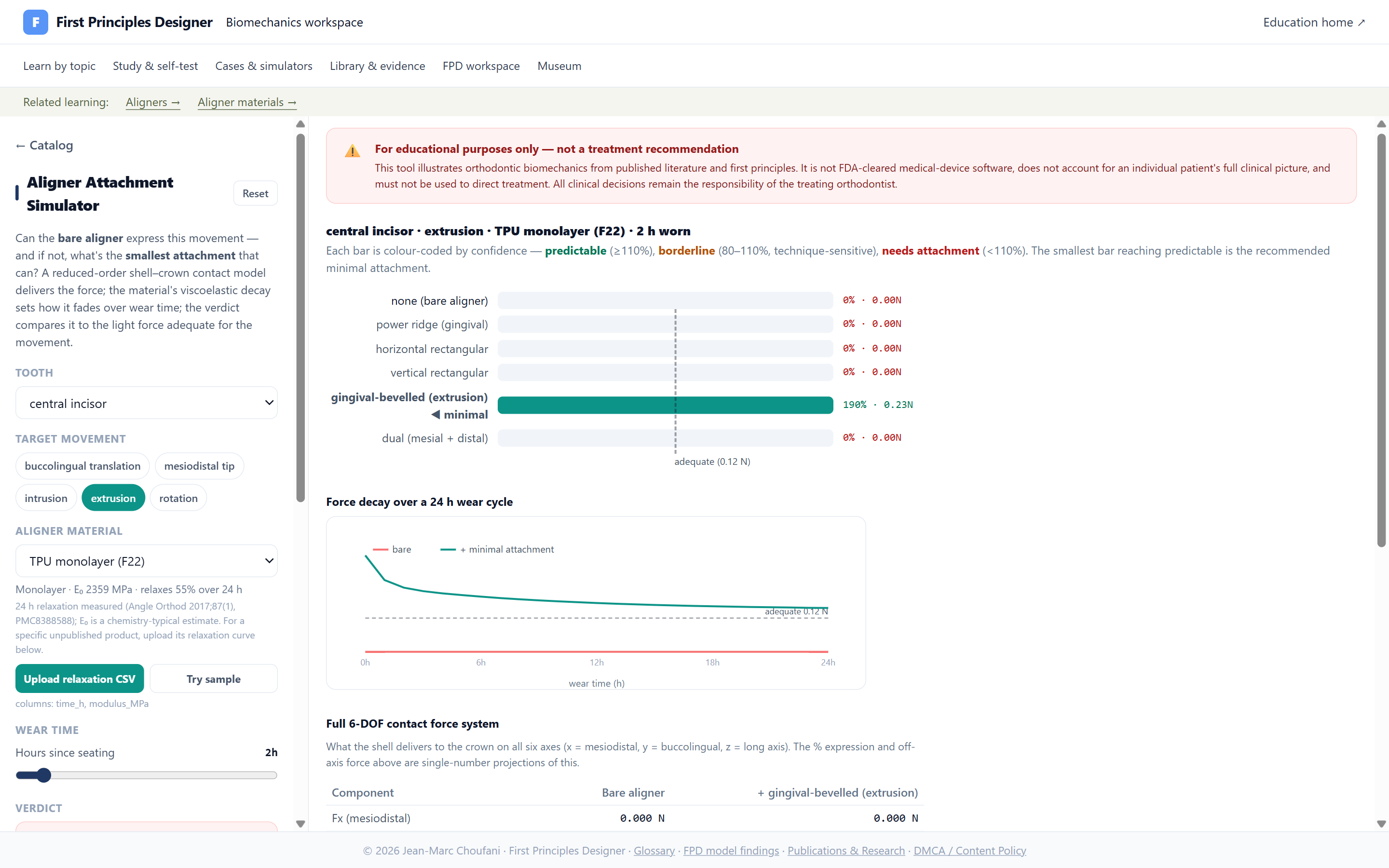
Why some movements need attachments and some don’t — from contact mechanics, not lore.
A reduced-order model of the aligner gripping the crown delivers the force system.
The plastic relaxes — see the force fall over the days an aligner is worn.
When the bare shell can’t express the move, the model finds the smallest attachment that can.
Extrusion and rotation are difficult cases in this reduced-order model, and attachments can change their initial force expression.
From a requested movement to an attachment decision.
Choose the tooth and the movement type — tip, rotate, or extrude.
See whether the aligner alone delivers enough force, now and after wear.
If needed, the model proposes the minimal attachment that expresses the movement.
The shell–crown contact model uses literature-calibrated assumptions to compare bare-aligner and attachment conditions. It illustrates expected initial tendencies but has not been externally validated for patient-specific prediction.
For reasoning about aligners instead of trusting the software black box.
Build real intuition before the clinic — change a parameter and watch the mechanics respond, instead of memorizing rules.
A fast sandbox to reason from first principles — concept-level understanding, never patient-specific advice.
A transparent teaching and research tool with cited inputs, exposed assumptions, and model-dependent outputs.
A bare aligner grips the smooth crown and can deliver some forces well (e.g. tipping) but struggles to grip for rotation and extrusion. An attachment adds a purchase point so the shell can deliver those force systems. The simulator shows when one is required.
The plastic is viscoelastic — it stress-relaxes over the days of wear, so the delivered force decays. The model shows this decay over wear time.
It's at no cost, with no signup, and runs entirely in your browser — nothing is downloaded or installed.
No. It is an educational and research simulation of general biomechanics using generic, user-entered parameters. It does not use patient data and is not intended for the diagnosis or treatment planning of individual patients.
No cost, in your browser, right now.
Launch the Aligner Simulator →