 OrthoTruss™
OrthoTruss™
OrthoTruss™
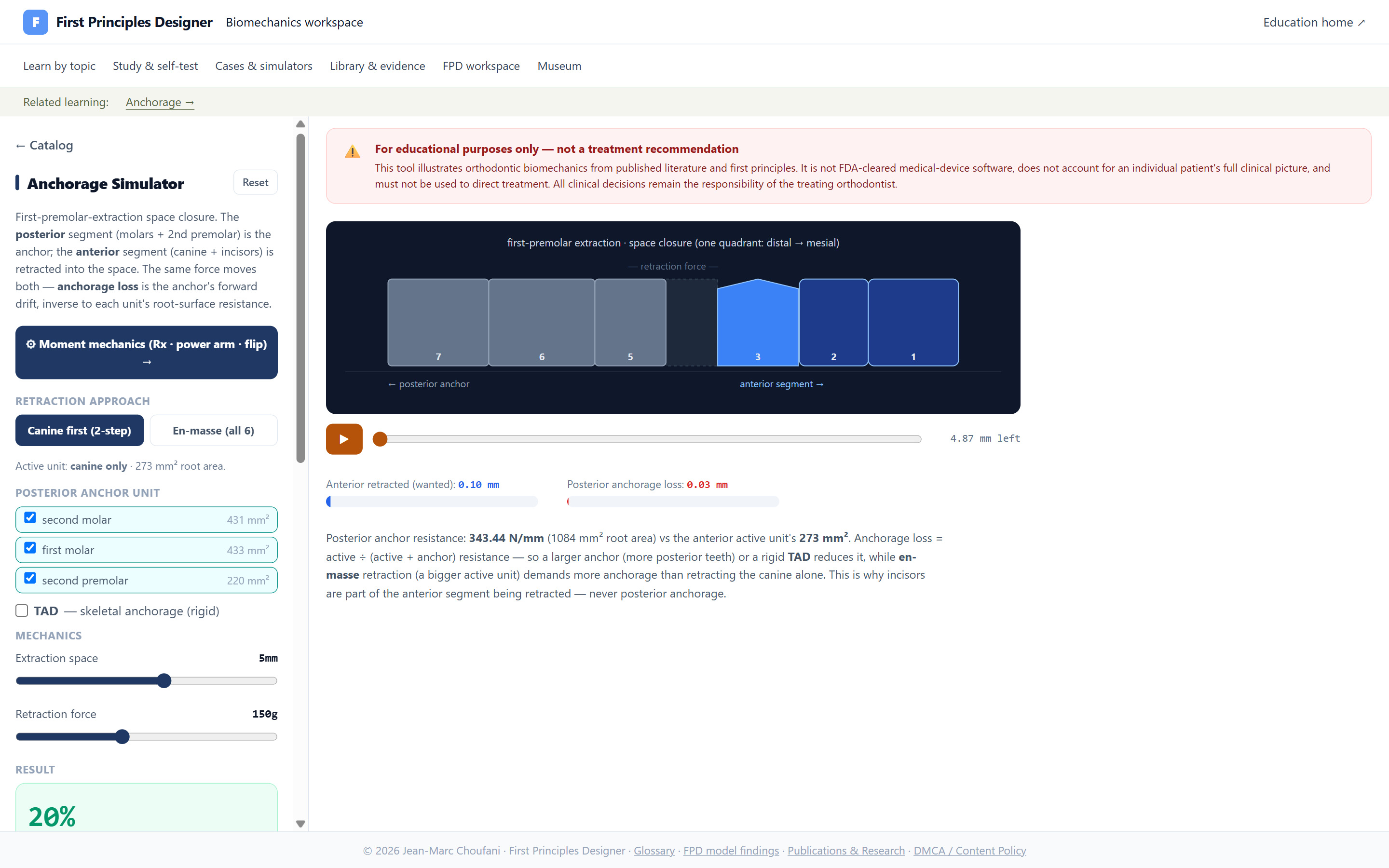
Retract a canine and watch the anchor unit drift forward by Newton's third law — inversely to root-surface resistance. Reinforce anchorage with more teeth or a skeletal TAD and see the loss drop to zero.
No install · No signup · Runs in your browser. Educational and research tool — not a medical device.
Anchorage is one of the most misunderstood ideas in orthodontics. Here it becomes something you can see.
Retract one unit and watch the reactive unit move — the loss is computed from the relative resistance of each side.
Each tooth resists in proportion to its root surface area — see why a molar anchors better than an incisor.
Add teeth to the anchor unit and watch the loss fall as the anchoring root surface grows.
Drop in a temporary anchorage device and see absolute anchorage — loss goes to zero.
From a retraction force to a quantified anchorage outcome.
Pick the active (moving) unit and the anchor unit — one tooth, several, or a TAD.
One retraction force acts on both units; the model splits the movement by relative resistance.
See the anchorage-loss percentage and how much each side actually moves.
The model reproduces its defined single-molar, reinforced-anchor, and idealized rigid-anchor reference cases. These are resistance-ratio mechanics checks, not clinical outcome validation.
For anyone who has tried to explain anchorage loss with a chalkboard.
Build real intuition before the clinic — change a parameter and watch the mechanics respond, instead of memorizing rules.
A fast sandbox to reason from first principles — concept-level understanding, never patient-specific advice.
A transparent teaching and research tool with cited inputs, exposed assumptions, and model-dependent outputs.
When you apply a force to move one tooth, an equal and opposite force acts on the anchor teeth, moving them in the unwanted direction. Anchorage loss is the fraction of your space that is consumed by that unwanted reactive movement.
A skeletal TAD anchors against bone rather than other teeth, so it does not move under the reactive force. The simulator shows anchorage loss falling to zero with a TAD.
It's at no cost, with no signup, and runs entirely in your browser — nothing is downloaded or installed.
No. It is an educational and research simulation of general biomechanics using generic, user-entered parameters. It does not use patient data and is not intended for the diagnosis or treatment planning of individual patients.
A multi-tooth resistance model where each tooth’s resistance scales with root surface area, part of the open Ortho-Biomechanics engine.
No cost, in your browser, right now.
Launch the Anchorage Simulator →