 OrthoTruss™
OrthoTruss™
OrthoTruss™
Design T-loops, L-loops, and vertical closing loops. Adjust gable bends, wire size, loop height, and position — and watch the force, the load-deflection rate, and the moment-to-force ratio update live.
No install · No signup · Runs in your browser. Educational and research tool — not a medical device.
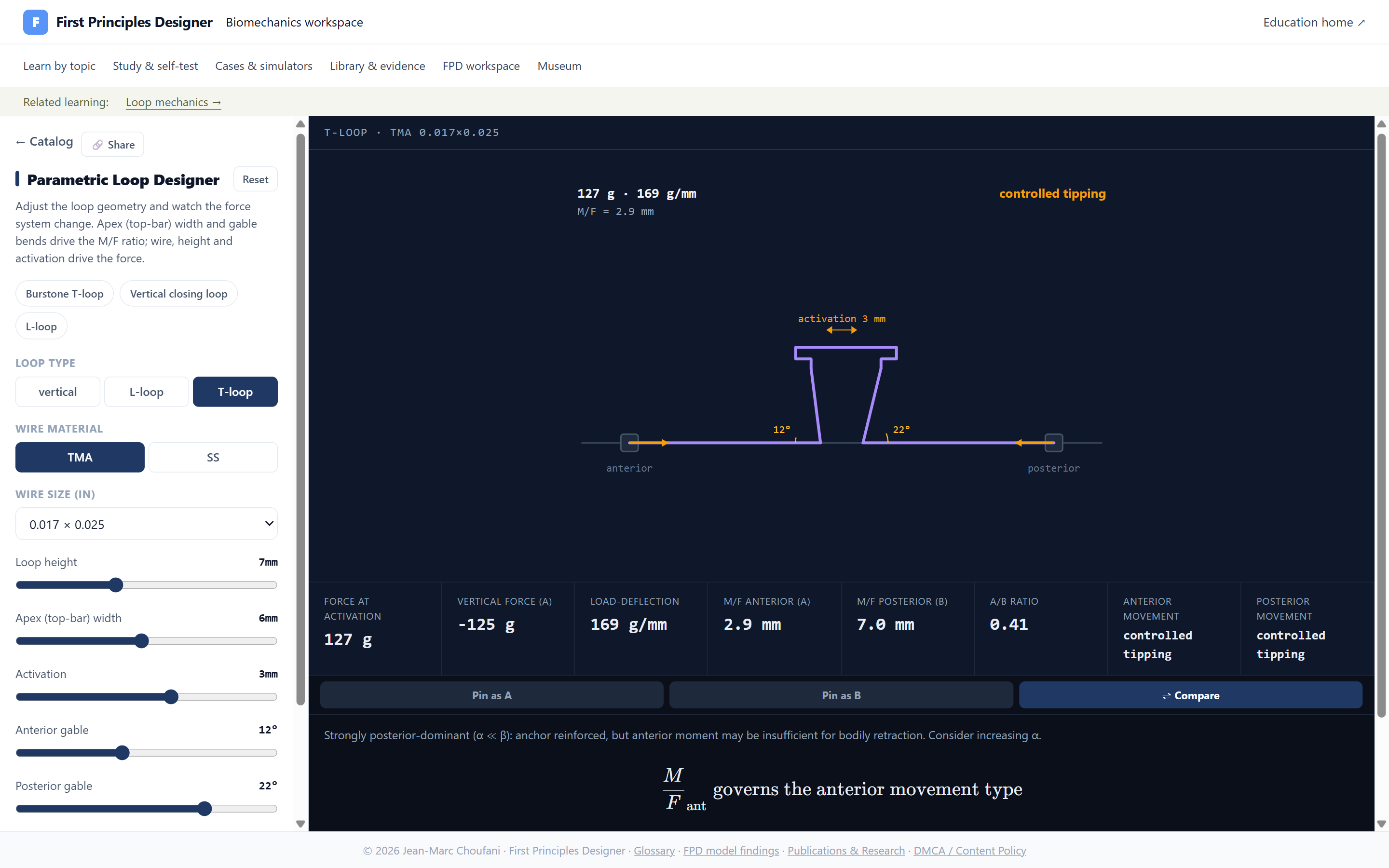
Loop mechanics from beam theory — every number traces to the wire and the geometry.
T-loop, L-loop, and vertical closing loops — switch and compare their force systems.
Add gable bends and watch the moment — and therefore the root control — change.
See how wire size, loop height, and material set the force-per-millimetre you deliver.
Tune the moment-to-force ratio to target tipping, controlled tipping, or translation.
A custom closing loop in three moves.
Choose a T-, L-, or vertical loop and a starting wire.
Set the height, position, and gable bends — the beam model recomputes the force system.
See delivered force, load-deflection rate, and the M/F ratio at the bracket.
Loop force and stiffness come from beam relationships keyed to wire cross-section and modulus, with behavior checked against analytical reference cases. The result describes the modeled initial force system, not fabrication or treatment-outcome validation.
For learning why a loop delivers the force it does.
Build real intuition before the clinic — change a parameter and watch the mechanics respond, instead of memorizing rules.
A fast sandbox to reason from first principles — concept-level understanding, never patient-specific advice.
A transparent teaching and research tool with cited inputs, exposed assumptions, and model-dependent outputs.
It is the force delivered per millimetre of activation. A lower rate gives a gentler, more constant force over the closing range — achieved with a taller loop, a smaller or more flexible wire, or added wire length.
Gable bends add a moment to the force system, raising the moment-to-force ratio so the roots are controlled during space closure rather than the crowns simply tipping together.
It's at no cost, with no signup, and runs entirely in your browser — nothing is downloaded or installed.
No. It is an educational and research simulation of general biomechanics using generic, user-entered parameters. It does not use patient data and is not intended for the diagnosis or treatment planning of individual patients.
No cost, in your browser, right now.
Launch the Loop Designer →