 OrthoTruss™
OrthoTruss™
OrthoTruss™
See the net tooth-moving force after friction in sliding mechanics. Cross the critical contact angle and watch binding consume the force — wire size, ligation, angulation, and lubrication all update live.
No install · No signup · Runs in your browser. Educational and research tool — not a medical device.
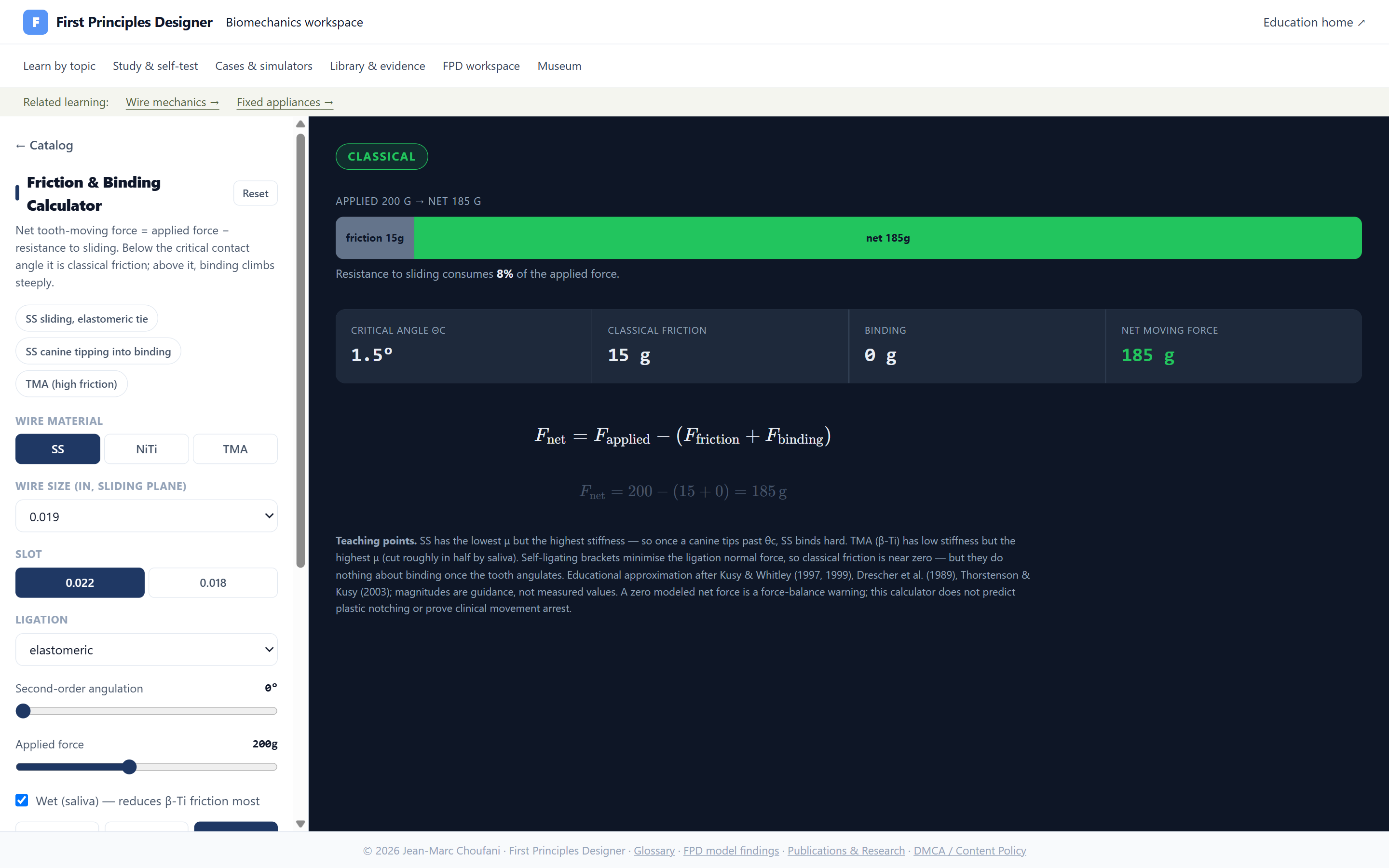
Friction is not one number — it is a regime that changes the moment the wire and bracket bind.
Below the critical contact angle, resistance is the familiar wire–bracket friction.
See the angle at which the wire contacts the bracket corners and binding begins.
Past the critical angle, binding dominates and can consume nearly all the applied force.
Self-ligating vs elastomeric, dry vs saliva — see how each shifts the resistance.
From applied force to what actually reaches the tooth.
Wire size and material, bracket slot, ligation method, and tooth angulation.
Increase angulation and watch the resistance jump as binding begins.
See how much of the applied force is left to actually move the tooth.
The model distinguishes classical friction from angle-dependent binding around the critical contact angle — reproducing the well-documented result that, in sliding mechanics, binding (not classical friction) is usually the dominant source of resistance.
For understanding why sliding mechanics “stick.”
Build real intuition before the clinic — change a parameter and watch the mechanics respond, instead of memorizing rules.
A fast sandbox to reason from first principles — concept-level understanding, never patient-specific advice.
A transparent teaching and research tool with cited inputs, exposed assumptions, and model-dependent outputs.
It is the angulation between wire and bracket at which the wire first contacts the slot corners. Below it, resistance is classical friction; above it, binding rises steeply and can consume most of the applied force.
It reduces classical friction from ligation, but once the critical contact angle is exceeded, binding dominates regardless of ligation type. The calculator shows both regimes.
It's at no cost, with no signup, and runs entirely in your browser — nothing is downloaded or installed.
No. It is an educational and research simulation of general biomechanics using generic, user-entered parameters. It does not use patient data and is not intended for the diagnosis or treatment planning of individual patients.
No cost, in your browser, right now.
Launch the Friction Calculator →