 OrthoTruss™
OrthoTruss™
OrthoTruss™
Two teeth, two 0.022 slots, one wire. Change interbracket distance, wire size and material, and each tooth’s inclination — and watch the wire deflect and the force system (moments, force, slot play) update live in 3D.
No install · No signup · Runs in your browser. Educational and research tool — not a medical device.
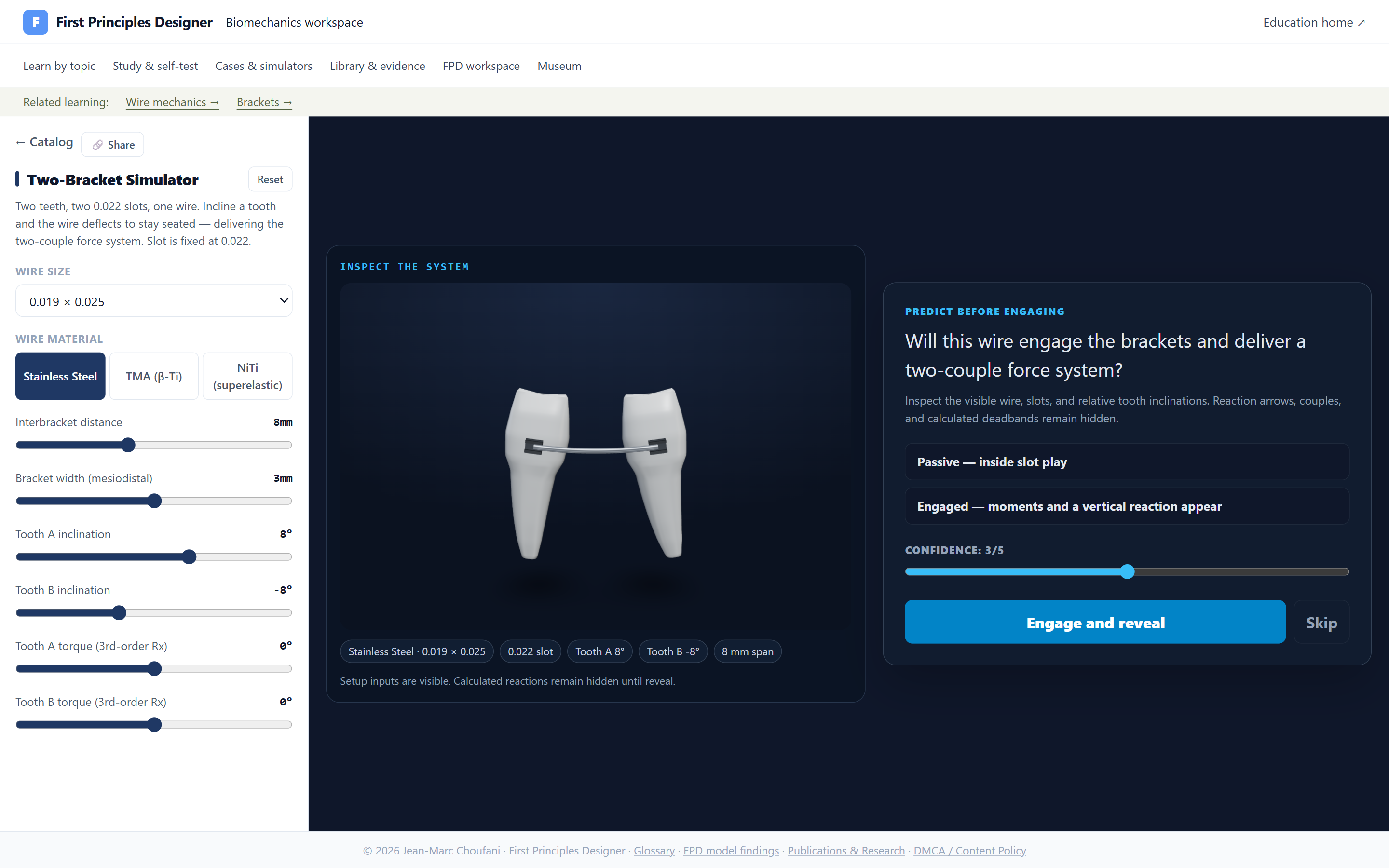
The two-bracket, one-wire system is the atom of fixed appliance mechanics.
Watch the archwire bend in real time as you change the teeth and the wire.
See how span sets the wire stiffness — closer brackets mean a stiffer, higher-force span.
Inclining a tooth engages the slot and generates a couple — the basis of torque.
See the play between wire and 0.022 slot, and when the wire finally engages.
Build a two-tooth force system and read it directly.
Choose each tooth’s inclination and the interbracket distance.
Pick wire size and material; the beam model deflects it through both slots.
See the force at each bracket, the couples, and the remaining slot play in 3D.
The wire is solved as a beam engaged in two bracket slots — so the forces and couples obey equilibrium (equal-and-opposite forces, balancing moments) exactly as a two-couple orthodontic system must.
For seeing torque, play, and couples instead of imagining them.
Build real intuition before the clinic — change a parameter and watch the mechanics respond, instead of memorizing rules.
A fast sandbox to reason from first principles — concept-level understanding, never patient-specific advice.
A transparent teaching and research tool with cited inputs, exposed assumptions, and model-dependent outputs.
It is the angular slack between a rectangular wire and the 0.022 bracket slot before the wire engages the slot walls. Until play is taken up, no torque (couple) is expressed. The simulator shows when engagement happens.
A wire spanning a shorter distance is stiffer and delivers more force for the same deflection. Increasing the span lowers stiffness and softens the force — visible live as you drag the brackets apart.
It's at no cost, with no signup, and runs entirely in your browser — nothing is downloaded or installed.
No. It is an educational and research simulation of general biomechanics using generic, user-entered parameters. It does not use patient data and is not intended for the diagnosis or treatment planning of individual patients.
No cost, in your browser, right now.
Launch the Two-Bracket Simulator →