 OrthoTruss
Deep Dive
Reading the Face
Chapter 2 of the tour sketches this arc in a page: Lavater's face-reading fad, Camper's facial angle, Retzius's cephalic index, Morton's skull collection, Lombroso's "born criminal," Galton's composite photographs. Each name gets a sentence or two — enough to place it in a larger pattern of pseudoscience wearing the clothes of empirical measurement. This deep-dive slows down on three things the tour chapter can only gesture at: what Johann Caspar Lavater actually claimed, and why nearly all of literate Europe read him; the sharp, contemporaneous rebuttal a fellow German intellectual wrote against him within Lavater's own lifetime, using Lavater's own method against itself; and the specific mechanical throughline connecting a Dutch anatomist's angle, a Swedish anatomist's ratio, a French anatomist's measuring program, an Italian physician's criminology, and an English polymath's photographic technique — five projects across a century, one continuous, wrong idea passed hand to hand.
Lavater's system: the face as a moral document
Johann Caspar Lavater was a Zurich pastor, not a scientist, and his physiognomics grew directly out of his theology: he held that God had made the outer body a legible trace of the inner soul, so that a sufficiently trained eye could read virtue, vice, intellect, and temperament straight off a person's static features — the slope of a forehead, the set of a jaw, the proportions of a profile caught in silhouette. A lecture he gave on the subject was published without his consent in 1772 as Von der Physiognomik.1 Over the following six years Lavater expanded that lecture into a sprawling, four-volume, lavishly illustrated project, Physiognomische Fragmente, zur Beförderung der Menschenkenntniss und Menschenliebe ("Physiognomic Fragments, for the Advancement of Human Knowledge and the Love of Humanity"), issued in installments from 1775 through 1778, with engravings after Daniel Chodowiecki, Johann Rudolf Schellenberg, and Johann Heinrich Lips.2
The Fragmente was not a quiet academic treatise; it was one of the best-selling books in Europe for a generation. It was pirated, abridged, and translated into English, French, Dutch, and Italian within a decade, and profile-silhouette reading became a genuine fashion — sitters commissioned silhouettes specifically so a physiognomist, professional or amateur, could "read" them, and Lavater's plates supplied the template everyone imitated. The book's cultural reach mattered independently of whether its claims were true: it normalized the idea, across an entire literate European public, that a face was a text with a fixed, decodable meaning, and that reading it correctly was a skill anyone could learn from a manual. That premise — legible character, fixed in visible form, rankable by an observer — is the exact premise the rest of this chapter's craniometric and criminological projects also needed, and Lavater is where it became mass culture rather than a specialist's private conviction.
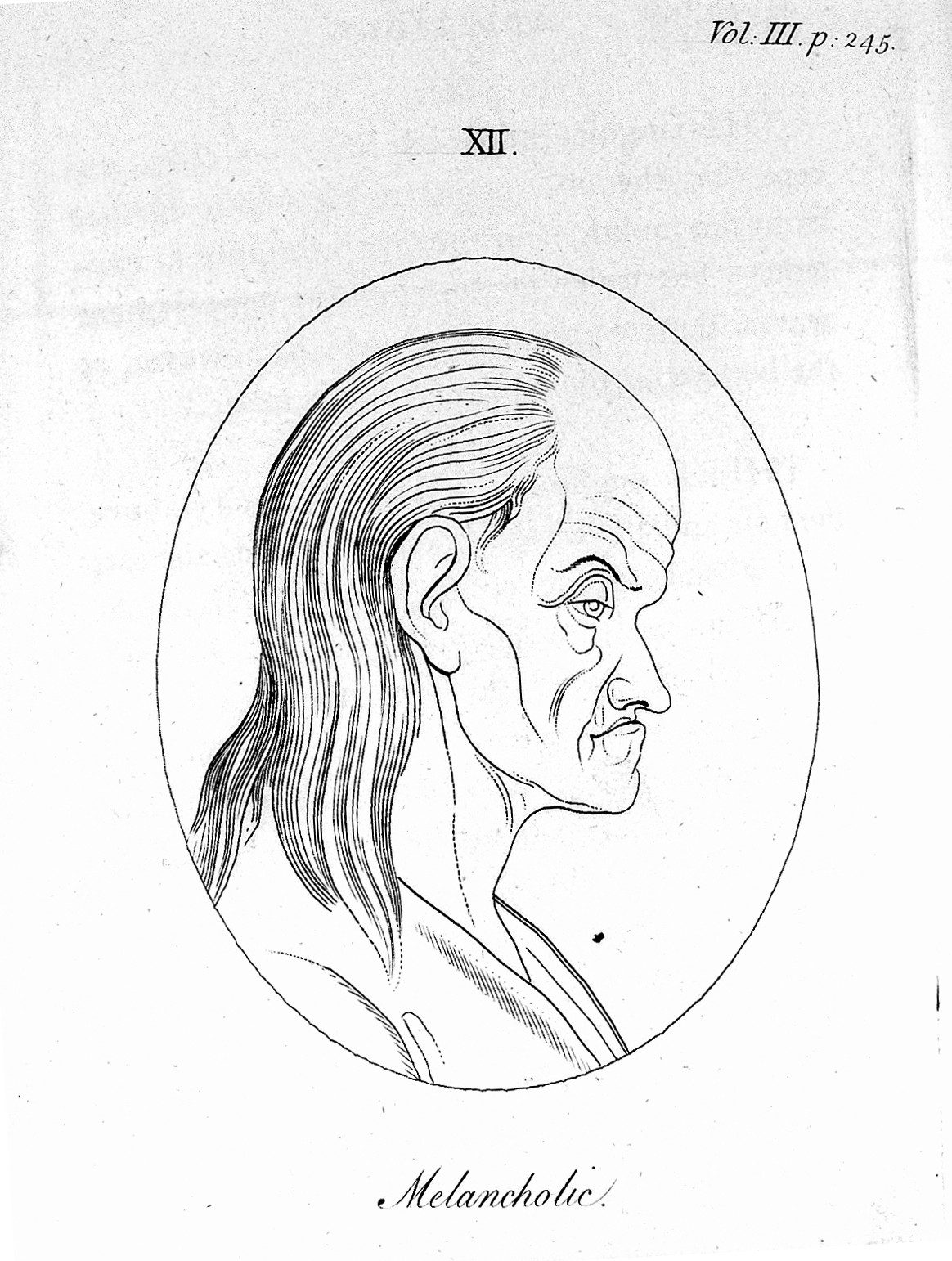
None of Lavater's central claim survives scrutiny. No measurable feature of a resting face reliably predicts moral character, intelligence, or temperament, and his own working method was frankly circular: he typically already knew who he was reading, and later editions of the Fragmente quietly revised earlier character judgments once a subject's reputation had changed. Even sympathetic contemporaries worried the system was unfalsifiable — any outcome could be explained after the fact by picking a different feature to emphasize. That circularity is exactly what the next section's critic went after, in print, while Lavater's fame was still at its height.
Lichtenberg's rebuttal, from inside the same decade
Physiognomy's most effective eighteenth-century critic was not a later historian working with the benefit of hindsight — he was a contemporary, publishing against Lavater while the Fragmente was still appearing volume by volume. Georg Christoph Lichtenberg was an experimental physicist and professor at Göttingen, known today for his aphorisms and for early work in electrostatics (the branching "Lichtenberg figures" are named for him). In 1778 he published Über Physiognomik, wider die Physiognomen, zur Beförderung der Menschenliebe und Menschenkenntniß ("On Physiognomy, Against the Physiognomists, for the Promotion of the Love of Humanity and of Human Knowledge") — a direct, sustained rebuttal of Lavater's method, not a vague objection to face-reading in general.3
Lichtenberg's argument had a scientist's shape to it. He pointed out that Lavater's silhouettes captured only a fixed outline and discarded everything a real face actually communicates — motion, expression, the thousand small muscular adjustments that carry meaning in a living person and vanish the instant the profile is traced. He argued the method was structurally unfalsifiable: because a physiognomist reading a silhouette usually already knew (or could guess) the sitter's reputation, any judgment could be quietly fitted to what the reader already believed, with no independent check available. And he was blunt about the comparison this invited — treating physiognomy as continuous with palm-reading and fortune-telling, a return to old superstition wearing the vocabulary of a new science. In a companion satirical piece written in the same period, he pushed the argument to absurdity by applying Lavater's silhouette method to profiles that plainly carried no moral information at all — the outlines of dogs' tails, pigs' tails, and gentlemen's powdered queues — daring readers to notice that the "reading" process worked identically on meaningless shapes.
Lichtenberg's rebuttal did not stop the Fragmente from becoming a European sensation, and it did not stop physiognomic thinking from feeding directly into the craniometric projects that followed it by decades. But it matters for this history precisely because it shows the pseudoscience was never uncontested even on its home ground and in its own moment — a rigorous, structurally sound critique existed from the start, made by someone with the scientific standing to be taken seriously, and it was simply outcompeted by a much larger cultural appetite for a legible, rankable face.
From an angle to a program: Camper, Retzius, Broca
Physiognomy read soft tissue and expression; the generation after Lavater shifted the same impulse onto bone, where a measurement could be written down as a number and compared. The Dutch anatomist Petrus Camper developed the first widely adopted version of this move during the 1770s, publishing it posthumously in 1791: the "facial angle," the angle formed between a line drawn from the forehead to the upper lip and a second line from the ear canal to the base of the nose.4 Camper's own stated purpose was comparative anatomy and classical aesthetics — he was interested in why certain proportions in Greek statuary read as ideal, and in charting angle differences across animal skulls. He did not build his angle into a racial hierarchy. Other writers did that for him almost immediately after his death, reading a steeper angle as evidence of higher standing and stacking populations into a ladder by measured degree — the pattern that recurs through everything that follows.
In 1842 the Swedish anatomist Anders Retzius introduced a second measurement, the cephalic index: skull breadth divided by skull length, multiplied by 100, sorting skulls into categories such as "dolichocephalic" (long-headed) and "brachycephalic" (broad-headed).5 Retzius developed the index working on Scandinavian archaeological remains, sorting older and more recent burial populations — again, not originally a global racial ranking. As a raw ratio it is measurable and real; skulls do vary continuously in breadth-to-length proportion. What was not real was the inference layered on top: that a head-shape category tracked a fixed, heritable racial type with a fixed capacity, rather than a trait that shifts across generations with environment, nutrition, and ordinary population variation.
That inference did not stay abstract, and it came home to Retzius's own country. In 1922 Sweden opened the world's first government-funded institute for "racial biology" in Uppsala, and by 1926 its director had used Retzius's cephalic index to sort 47,387 Swedish military conscripts — roughly half the country's young men of that age — into "Nordic" and lesser head-shape categories.6 A descriptive ratio had become, six decades after its inventor's death, an instrument of state.
The measurement that turned these individual angles and ratios into an institutional program was Paul Broca's. Broca, a French surgeon and neuroanatomist with a genuine and lasting scientific legacy elsewhere (the brain region governing speech production still bears his name), founded the Société d'Anthropologie de Paris and, in 1875, published Instructions craniométriques — a standardized protocol of landmarks, instruments, and procedures for measuring skulls, intended to make craniometry consistent across laboratories and observers.7 The instructions were technically careful. What they systematized was not neutral: a standardized measuring protocol lent the trappings of rigor and reproducibility to a ranking project whose underlying premise — that skull shape indexes worth or capacity — had no support to begin with. Broca's own published rankings, like Morton's discussed next, consistently placed white Europeans at the top. Precision in the measuring did not make the conclusion any truer; it made the conclusion look more scientific while remaining just as wrong.
Morton's skulls and Lombroso's "born criminal"
The Philadelphia physician Samuel George Morton assembled one of the era's largest skull collections and used cranial capacity — literally how much seed or lead shot a skull could hold — to rank populations by presumed intelligence in his 1839 Crania Americana.8 His rankings placed white Europeans at the top and enslaved and colonized peoples at the bottom, and the book was cited for decades afterward as scientific backing for slavery and colonial rule. In 1981, Stephen Jay Gould's The Mismeasure of Man made Morton the textbook case of unconscious bias, arguing he had unconsciously mismeasured skulls to favor his own hierarchy. But when a team physically remeasured nearly half of Morton's surviving skulls in 2011, his original figures mostly held up, and the most over-measured skulls did not fit the pattern Gould's bias theory predicted — they belonged to an Egyptian Copt, a Seminole, and a Native African.9 Later work in turn partly defended Gould, and the exchange remains an open dispute in the history of science.10 What no side contests is the deeper point, which the more "rigorous," Broca-style protocols that followed Morton never fixed either: the flaw was never in the precision of the measuring, but in the premise that a skull's volume says anything at all about the worth of the mind that once occupied it.
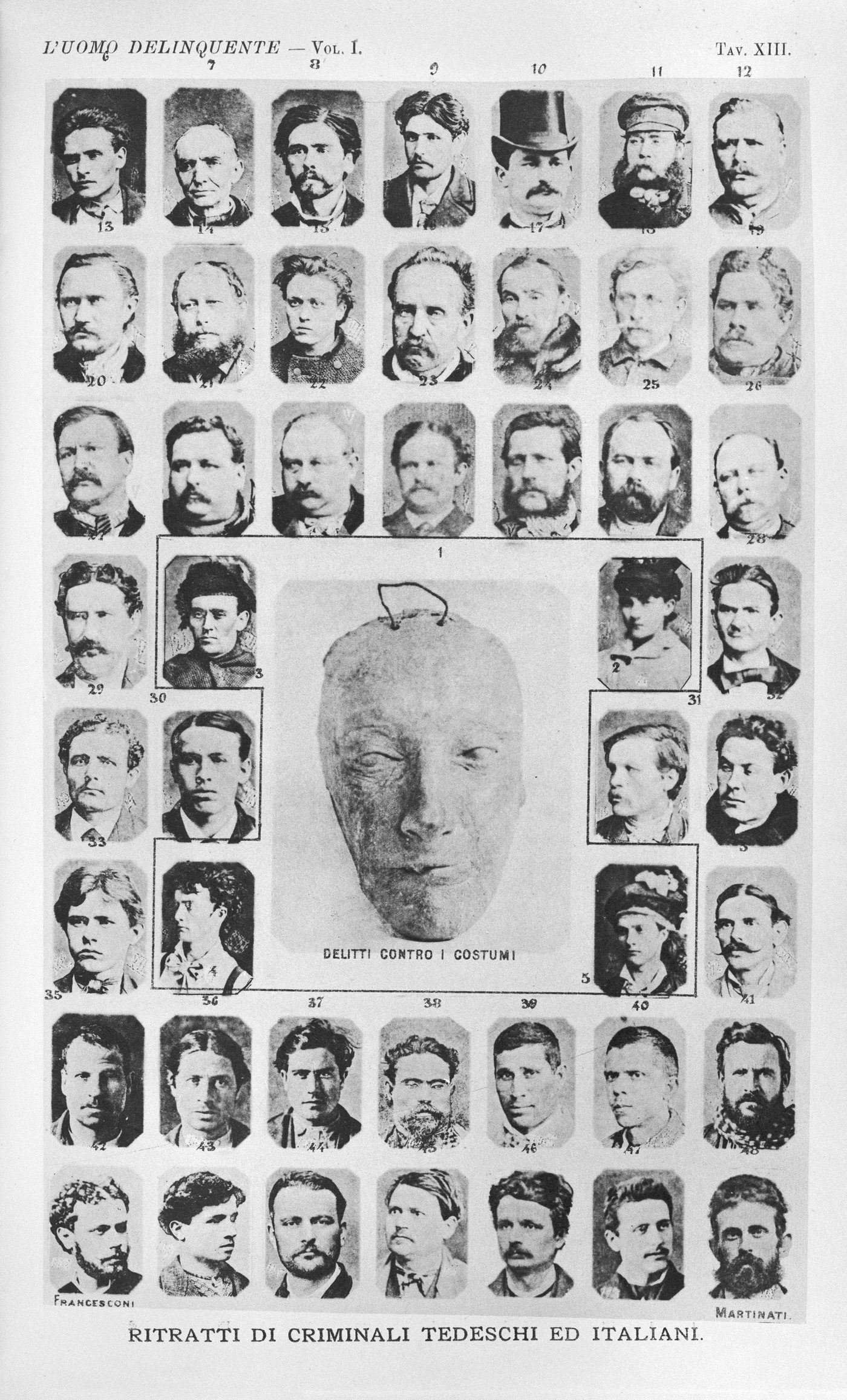
The Italian physician Cesare Lombroso pushed the same craniometric logic into criminal law. His 1876 L'uomo delinquente ("Criminal Man") argued that criminals were a recognizable biological type, identifiable by inherited physical "atavisms" — a sloping forehead, heavy brow ridges, an asymmetric jaw, unusual ear set — that marked a throwback to an earlier, more primitive evolutionary stage.11 Lombroso built his catalogue of "criminal" features on skull and body measurements taken the same way Broca's protocol prescribed, applied to prison populations rather than archaeological ones — the craniometric measuring program feeding directly into a new claim about who was predisposed to crime before committing any. The "born criminal" had no biological reality: no cluster of facial or cranial measurements predicts criminal behavior, and Lombroso's case selection — examining people already convicted and already fitting his preconceptions — could never have distinguished a real biological marker from a self-fulfilling one. The theory nonetheless founded what became known as the Italian School of criminology and shaped courtroom practice, immigration screening, and eugenic sterilization policy across Europe and the United States well into the twentieth century, feeding a habit of targeting people by appearance rather than by conduct.
The instrument-worship outlasted criminology. After a series of séances with the medium Eusapia Palladino beginning in 1891, Lombroso reversed a lifetime of declared skepticism about spiritualism and, in a book finished at the very end of his life, defended her table-levitations as genuine — insisting he had measured them with proper scientific instruments.12 A credentialed measurer convincing himself his instruments had proven what he already wanted to believe is the same failure that produced the "born criminal," playing out where there was no real ambiguity about what was happening.
Galton's composites: a real technique, a false target
Francis Galton took a different route to the same "criminal type" Lombroso was chasing in print. In 1878 he described composite photography: superimposing multiple exposures of different individuals' faces, aligned on the eyes, onto a single photographic plate to produce one blended, averaged portrait.13 The photographic technique itself was, and is, a legitimate method — image averaging is a real and reproducible optical procedure, still used today in perception research for exactly the same reason Galton used it: it produces a single representative face out of many individual ones. The pseudoscience was never in the averaging; it was in what Galton set out to find with it.
Galton obtained photographs of convicted prisoners, supplied by British prison administrators sorted by offense type, and produced composites hoping each category — violent offenders, thieves, forgers — would reveal a shared, visible "criminal" physiognomy: photographic proof for the same claim Lombroso was making from calipers and case notes. It did not deliver that proof. Galton himself judged the criminal composites a failure on their own terms: rather than sharpening into a distinctive "type," the blended faces became smoother, more symmetric, and more generically ordinary-looking than any of the individual photographs that went into them — an artifact of averaging out individual variation, not a discovered category. He drew the intended lesson only partway, concluding criminality was more a matter of circumstance and behavior than of fixed physical type; he nonetheless went on, in the following years, to apply the same composite method to other groups he wanted to characterize as a fixed "type," including a "Jewish type," treating the technique as though it could reveal biological essence rather than merely an average outline.
The failure of the criminal composites turned out to be scientifically informative for an entirely different reason than the one Galton was chasing. Later, unrelated research on face perception found that averaged, composite faces are consistently rated as more attractive than most of the individual faces that go into them — not because averageness marks any inner quality, but because blending faces together smooths out the idiosyncrasies and asymmetries that make individual faces look distinctive, and viewers reliably prefer that smoothed result.14 Galton had, without meaning to, produced early evidence for a genuine finding about face perception while failing completely at the pseudoscientific project he set out to prove.
One idea, five projects, a century
Lay the chain end to end and the continuity is more striking than any single figure in it. Lavater made the face a legible moral text and turned reading it into mass culture. Camper and Retzius converted that impulse from soft-tissue impression into a bony number, each while explicitly disclaiming any racial ranking as his own purpose. Broca built a standardized measuring program that made the numbers look rigorous without making the underlying premise any truer. Morton had reached for that same appearance of rigor decades before Broca formalized it, with his own skull-collection methods; Lombroso later drew on Broca's protocol directly. Both used the look of measurement to rank populations and to invent a criminal "type," both projects doing enormous real-world harm — justifying slavery and colonial rule in Morton's case, shaping criminology, immigration policy, and eugenic sterilization law in Lombroso's. And Galton, working in photographs rather than calipers, chased the identical criminal-type target with a genuinely sound technique and produced only further evidence that the target did not exist.
Lichtenberg's contemporaneous rebuttal, arriving before any of the craniometric chapters of this story had even begun, is the detail worth holding onto: the flaw at the center of all five projects — fixed, visible, rankable character — was identifiable on first principles in 1778, by a working scientist, using arguments that still hold. It did not require a century of skulls, calipers, and photographic plates to see the mistake; the mistake was legible from the very first move, treating continuous human variation as though it sorted into fixed types. What the century of instruments that followed actually supplied was not correction — it was the appearance of precision draped over a premise that precision could never rescue.
Further reading
Reading the Face
The shorter tour version of this history: physiognomy, craniometry, and the invented science of faces.
The Skull That Broke Race Science
Boas 1912 and the re-analysis war that still isn't settled.
The Machine Gaze
The same "reading identity from measurement" impulse, automated.
References
- (1772). Von der Physiognomik. Leipzig: Weidmanns Erben und Reich. ↩
- (1775). Physiognomische Fragmente, zur Beförderung der Menschenkenntniss und Menschenliebe. Leipzig und Winterthur: Weidmanns Erben und Reich, und Heinrich Steiner und Compagnie. ↩
- (1778). Über Physiognomik, wider die Physiognomen, zur Beförderung der Menschenliebe und Menschenkenntniß. Göttingen: Johann Christian Dieterich. ↩
- (1791). Dissertation physique sur les différences réelles que présentent les traits du visage chez les hommes de différents pays et de différents âges. Utrecht: B. Wild & J. Altheer. ↩
- (1842). Om formen af nordboernes cranier. Förhandlingar vid de Skandinaviske Naturforskarnes tredje möte, 3, 157–201. ↩
- (2020). Race biology. Hereditas, 157, 48, on the Swedish State Institute for Racial Biology (Uppsala, 1922); the 47,387-conscript survey is from Herman Lundborg & F. J. Linders, The Racial Characters of the Swedish Nation (Uppsala: Almqvist & Wiksell, 1926). ↩
- (1875). Instructions craniométriques. Bulletins de la Société d'Anthropologie de Paris, 2e série, 10, 429–435. ↩
- (1839). Crania Americana; or, a Comparative View of the Skulls of Various Aboriginal Nations of North and South America. Philadelphia: J. Dobson. ↩
- (2011). “The Mismeasure of Science: Stephen Jay Gould versus Samuel George Morton on Skulls and Bias.” PLoS Biology 9(6): e1001071. ↩
- (2016). Morton, Gould, and Bias: A Comment on “The Mismeasure of Science.” PLoS Biology, 14(4), e1002444. ↩
- (1876). L'uomo delinquente, studiato in rapporto alla antropologia, alla medicina legale ed alle discipline carcerarie. Milano: Hoepli. ↩
- (1909). After Death—What? Spiritistic Phenomena and Their Interpretation. Boston: Small, Maynard & Co. (translation of Ricerche sui fenomeni ipnotici e spiritici, Turin: UTET). Séances with Eusapia Palladino began in 1891. ↩
- (1878). Composite portraits, made by combining those of many different persons into a single figure. Nature, 18(447), 97–100. ↩
- (1990). Attractive Faces Are Only Average. Psychological Science, 1(2), 115–121. ↩
_titelblad.jpg)