 OrthoTruss
Chapter 2
Reading the Face
Reading character in the face, everywhere and always
The idea that a face reveals inner character is old and geographically widespread, and it did not begin in Europe. Classical Indian samudrika shastra texts included face-reading among a broader system for forecasting fortune and temperament from bodily marks. Chinese mianxiang ("face reading") correlated features and proportions with fate and personality for centuries. In the Greek world, the pseudo-Aristotelian Physiognomonica, and a brief aside in the genuine Prior Analytics (2.27), proposed reading character by analogy between human and animal features. None of these were scientific by modern standards, but they show the impulse to read a face for hidden character is ancient and cross-cultural. The strand that later fused with European race science became something these other traditions never did.
Al-Razi, della Porta, and the physiognomic manual
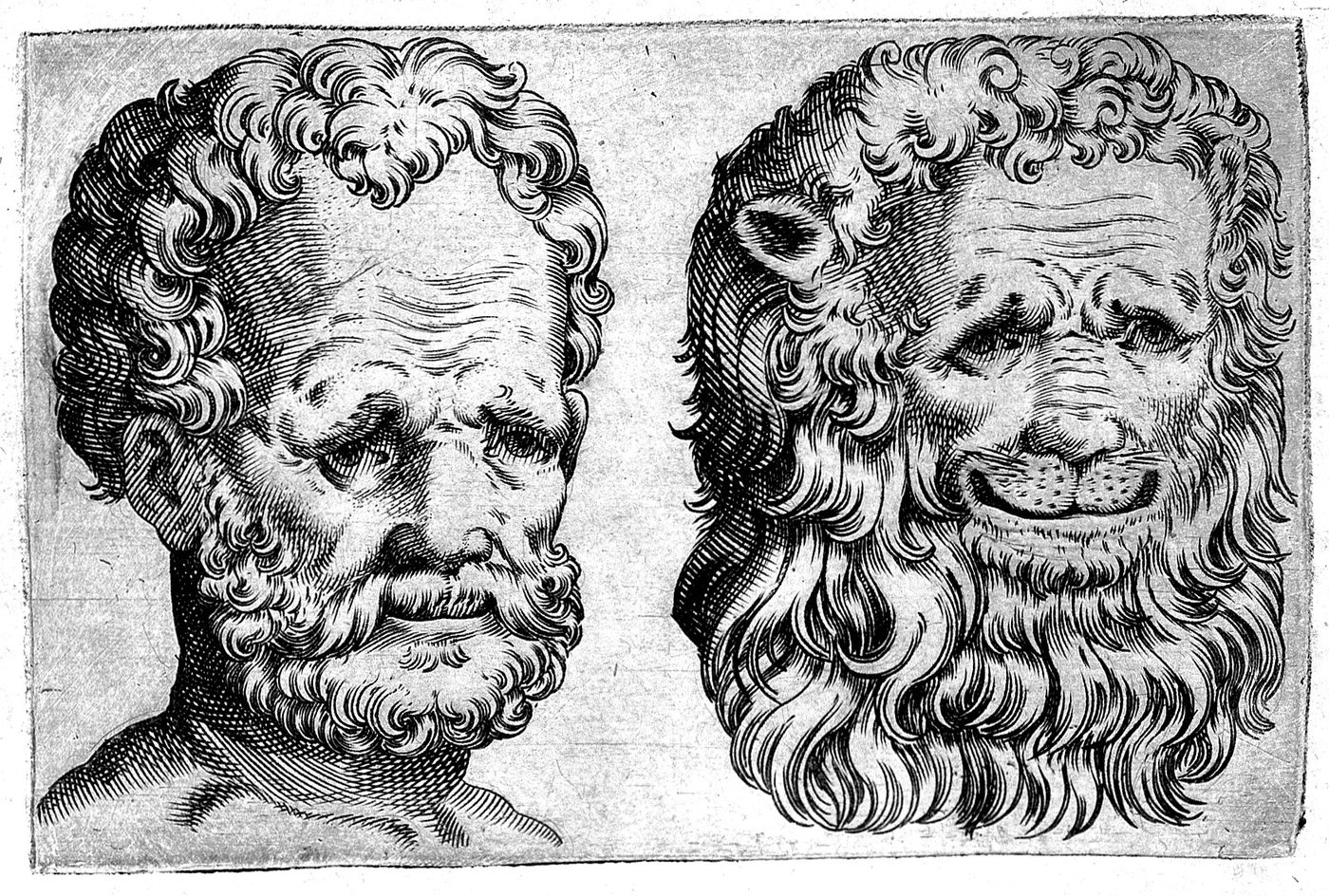
Medieval Islamic scholarship treated physiognomy (firasa) as a serious subject: the Persian theologian and polymath Fakhr al-Din al-Razi's Kitab al-Firasa ("Book of Physiognomy") catalogued correspondences between physical traits and character, an interpretive exercise rather than an experiment. Centuries later, the Neapolitan polymath Giambattista della Porta systematized the same project in print. His illustrated De humana physiognomonia (1586) paired woodcut portraits of people with woodcuts of animals — a lion-faced man, a bull-faced man — to argue visually that human character mirrored animal nature. Widely reprinted, it set a template later writers reused: pair an image with a claimed trait, and let the visual analogy substitute for evidence.
Lavater and the physiognomic fragment
The Swiss pastor Johann Caspar Lavater turned physiognomy into a European sensation. A lecture he gave in Zurich was published without his consent in 1772 as Von der Physiognomik, growing into his larger, lavishly illustrated Physiognomische Fragmente (1775–1778).1 Lavater read moral and intellectual character directly off features — a forehead's slope, a jaw's set — treating the face as a legible moral text. It had no predictive validity, and even correspondents doubted character could be read this reliably. But the book was a publishing phenomenon, and it laid cultural groundwork — a face as a readable surface of inner worth — that the next generation's pseudo-anatomists built on.
One of the era's most memorable tests came later, when Charles Darwin applied to join HMS Beagle. Darwin recalled that Captain Robert FitzRoy, an admirer of Lavater, nearly rejected him because the shape of his nose supposedly suggested a weak character. FitzRoy relented; the naturalist joined the voyage, and the anecdote survived as a small accidental experiment in the limits of reading character from a face.2
Gall, Spurzheim, and phrenology
Around 1800, the German physician Franz Joseph Gall proposed that the brain was a set of separate organs, each governing a faculty — combativeness, benevolence, acquisitiveness — whose size, read as bumps on the skull, indicated how strongly a person possessed that trait. His collaborator Johann Spurzheim renamed the system "phrenology" and popularized it across Britain and the United States, where it became a fashionable parlor practice and even a hiring filter. Its central claims do not survive scrutiny: skull bumps do not map to brain regions in any way that reflects real neuroanatomy. But tying head shape to fixed, rankable traits directly rehearsed the racial craniometry that followed within decades. The parlor side of the craze produced its own curiosities: in 1849 the poet Walt Whitman had his head read by the phrenologist Lorenzo Fowler, who awarded him a flattering chart Whitman liked enough to reprint — and to quote approvingly in an anonymous self-review — inside early editions of Leaves of Grass.3
Camper's facial angle
The Dutch anatomist Petrus Camper developed a measurement he called the "facial angle" — the angle between a line from forehead to upper lip and a line from ear canal to nose base — during the 1770s, publishing it posthumously in 1791.4 Camper's own purpose was aesthetic and comparative-anatomical, contrasting angles across animals and classical statuary. But the measurement was almost immediately repurposed as a ranking device, a steeper angle read as evidence of higher standing and used to build a hierarchy of populations — a descriptive geometric measurement turned into a ladder of human worth, the pattern running through the rest of this chapter.
Retzius and the cephalic index
In 1842, the Swedish anatomist Anders Retzius introduced the cephalic index: skull width divided by skull length, times 100, sorting skulls into categories like "dolichocephalic" (long-headed) and "brachycephalic" (broad-headed).5 As a raw ratio it is measurable and real. What is not real is the inference built on top of it — that head-shape categories track fixed racial types with fixed capacities. Cranial proportions vary continuously within any population and shift across generations with environment and nutrition; most reanalyses of the classic immigrant data read the cephalic index as measurably plastic within a single generation rather than the fixed racial marker craniometry assumed, though how much of that shift is environmental is itself contested — a dispute Chapter 3 takes up in full.678 The ratio survived as a footnote in anthropology; the racial theory built on it did not survive better evidence.
These labels are historical taxonomy, not biological categories — the cephalic index itself shifts within a single generation under environmental influence, not a fixed racial type.
Morton's skull collection and "Crania Americana"
The Philadelphia physician Samuel George Morton assembled one of the era's largest skull collections and used cranial capacity — how much seed or shot a skull could hold — to rank populations by presumed intelligence in his 1839 Crania Americana.9 His rankings placed white Europeans at the top and enslaved and colonized peoples at the bottom, and the work was cited for decades as scientific backing for slavery and colonial rule. What later re-examiners made of his data is itself a cautionary tale: in 1981 Stephen Jay Gould's The Mismeasure of Man made Morton a textbook case of unconscious bias, arguing he had mismeasured skulls to favor his own hierarchy — but a 2011 remeasurement of the surviving collection found Morton's own figures largely accurate and charged that Gould's critique was itself skewed, and later work has in turn partly defended Gould.1011 The rankings Morton built on the data were never valid; the lasting lesson is that even the exposure of bias gets re-examined for bias. His French contemporary Paul Broca, remembered today for genuine contributions to brain anatomy, pursued the same ranking project — real scientific skill and pseudoscientific racism sitting side by side in the same laboratories.
Lombroso's "born criminal"
The Italian physician Cesare Lombroso extended craniometric logic to criminology in his 1876 L'uomo delinquente ("Criminal Man"), arguing that criminals were identifiable by inherited physical "atavisms" — jaw shape, brow ridges, ear set — marking a throwback to an earlier evolutionary stage.12 The "born criminal" had no biological reality: no cluster of facial measurements predicts criminality, and Lombroso's case selection was never controlled enough to support the claim. The theory nonetheless shaped criminology and courtroom practice for decades, feeding into eugenic policy and into targeting people by appearance rather than conduct.
Lombroso later traced the whole theory to a single moment: examining the skull of a Calabrian laborer, Giuseppe Villella, in 1870, he found a small depression at its base and wrote that the criminal's nature was suddenly "lighted up... as under a flaming sky." He recorded the finding only years after Villella's 1864 autopsy — a founding "discovery" assembled well after the fact — and the skull itself remained the object of a museum controversy that an Italian appeals court did not settle until 2017.13
The same era's faith in the measured body as an identity met an embarrassing failure. Under the anthropometric identification system of Alphonse Bertillon — a fixed battery of body and head measurements meant to pin down a person for life — a man named Will West was booked into Leavenworth penitentiary in 1903 and found to match the file of a William West already imprisoned there: two apparently unrelated men whose measurements were nearly indistinguishable. The case became the standard cautionary tale for the shift from body-measurement to fingerprinting, though later historians note the story was polished in the retelling.14
Galton's composite photographs
Francis Galton developed composite photography in 1878: superimposing exposures of different individuals' faces on one plate to produce a blended, averaged portrait.15 He hoped composites of convicted criminals would reveal a shared "criminal type" — visual evidence for the same claim Lombroso was making in print. They did not deliver it; averaging faces mostly produces a smoother, more symmetric, unremarkable face, an artifact of blending rather than a discovered type. The typological project the technique served — sorting people into visible, rankable categories of worth — was the same one running through this whole chapter, and it was wrong every time.
The urge to quantify people did not stop at criminal composites. Galton carried a needle-and-thimble "pricker" concealed in his pocket to secretly rate the women he passed on the street as attractive, indifferent, or repellent, tallying the pinpricks into what he called a Beauty-Map of the British Isles — London ranked most beautiful, Aberdeen least. He conceded the result was "a purely individual estimate," which did not stop him from compiling it as data.16
Variation, not typology
Every measurement here — facial angle, cephalic index, cranial capacity, "atavistic" features — describes something that varies continuously across people, shaped by ancestry, environment, and chance. None of them sort humans into the fixed, ranked types physiognomy, craniometry, and phrenology all needed to be true. The measurements were often taken poorly, but the deeper failure is that the claim itself — visible traits track worth or capacity — was never supported by evidence, and it caused real harm wherever applied as policy. The history matters not because any of it holds up, but because it was taken as settled science in its own time, and reading fixed hierarchy into continuous variation keeps resurfacing in new packaging.
This taxonomy did not even stay in the criminology lab; it walked straight into clinical medicine. In 1866 the physician John Langdon Down sorted children with intellectual disability into Blumenbach's racial categories, describing what we now call trisomy 21 as a throwback to a "Mongolian" type. The label stuck in medical use for nearly a century, until a 1961 letter from nineteen geneticists led the World Health Organization to retire it in 1965.17 A physiognomic racial label attached to a chromosomal condition for ninety-nine years is a fair measure of how long these categories can outlive their own refutation.
Further reading
References
- (1772). Von der Physiognomik. Leipzig: Weidmanns Erben und Reich. ↩
- (1887). The Autobiography of Charles Darwin, chapter 2. Darwin Correspondence Project, “Joseph Simms, physiognomy”. ↩
- (1971). Heads & Headlines: The Phrenological Fowlers. Norman: University of Oklahoma Press. ↩
- (1791). Dissertation physique sur les différences réelles que présentent les traits du visage chez les hommes de différents pays et de différents âges. Utrecht: B. Wild & J. Altheer. ↩
- (1842). Om formen af nordboernes cranier. Förhandlingar vid de Skandinaviske Naturforskarnes tredje möte, 3, 157–201. ↩
- (1912). Changes in the Bodily Form of Descendants of Immigrants. American Anthropologist, 14(3), 530–562. ↩
- (2003). Heredity, Environment, and Cranial Form: A Reanalysis of Boas's Immigrant Data. American Anthropologist, 105(1), 125–138. ↩
- (2002). A Reassessment of Human Cranial Plasticity: Boas Revisited. Proceedings of the National Academy of Sciences, 99(23), 14636–14639. ↩
- (1839). Crania Americana; or, a Comparative View of the Skulls of Various Aboriginal Nations of North and South America. Philadelphia: J. Dobson. ↩
- (2011). “The Mismeasure of Science: Stephen Jay Gould versus Samuel George Morton on Skulls and Bias.” PLoS Biology 9(6): e1001071. ↩
- (2016). Morton, Gould, and Bias: A Comment on “The Mismeasure of Science.” PLoS Biology, 14(4), e1002444. ↩
- (1876). L'uomo delinquente, studiato in rapporto alla antropologia, alla medicina legale ed alle discipline carcerarie. Milano: Hoepli. ↩
- (2018). The trial of the skull studied by the founder of Criminal Anthropology: The war of the Lombroso Museum. Journal of Forensic and Legal Medicine, 59, 13–15. Lombroso’s “flaming sky” account is quoted from Criminal Man, trans. Mary Gibson & Nicole Hahn Rafter (Duke University Press, 2006). ↩
- (2001). Suspect Identities: A History of Fingerprinting and Criminal Identification. Cambridge, MA: Harvard University Press. ↩
- (1878). Composite portraits, made by combining those of many different persons into a single figure. Nature, 18(447), 97–100. ↩
- (1908). Memories of My Life, chapter XXI. London: Methuen & Co. ↩
- (1866). Observations on an Ethnic Classification of Idiots. London Hospital Reports, 3, 259–262. Retired from clinical use by the World Health Organization in 1965 following a 1961 letter from nineteen geneticists. ↩
_titelblad.jpg)