 OrthoTruss
Proportion & Beauty
Proportion Dreams
The Egyptian grid
Long before anyone wrote a theory of beauty, Egyptian artisans had a working method for producing consistent faces and bodies at scale. Tomb and temple walls were laid out on a grid — a canon of fixed unit-proportions — so that a standing figure's height, and the placement of shoulders, waist, and knees within it, could be reproduced by any trained hand across centuries of workshops. The grid was not a claim about what made a face beautiful; it was a production tool, a way to keep royal and divine imagery legible and consistent across Egypt's long visual tradition. That distinction — a working convention for reproducibility versus a theory of ideal form — is worth holding onto, because the two get conflated constantly in everything that follows.
The grid was not even fixed within Egypt. When Akhenaten remade Egyptian religion around the sun-disc Aten in the mid-1300s BCE, his court remade the canon too, inserting extra grid squares to stretch the neck and torso into the distinctive elongated figures of Amarna-period royal art — and later reigns restored the older proportions along with the older gods, though the stylistic reversion lagged the religious one by more than a generation. 1 The oldest "canon" in this whole chapter was itself a revisable production tool, not a fixed law of beauty.
Polykleitos and symmetria
Greek sculpture inherited the impulse toward canon but gave it a philosophical gloss. The sculptor Polykleitos, working in the fifth century BCE, wrote a treatise — now lost, known only through later citations — called the Canon, and made a sculpture, the Doryphoros ("Spear-Bearer"), to demonstrate it. The Greek term at the center of this project was symmetria, and it is routinely mistranslated. It did not mean mirror symmetry, and it did not point at a single magic ratio. It meant commensurability: that the parts of a body should relate to each other and to the whole through small, well-defined whole-number ratios, the way musical intervals relate to each other in a consonant scale. Polykleitos's project was closer to harmonic proportion theory than to a search for one privileged number. Later writers, hunting backward for a tidier story, would try to collapse symmetria into a single ratio — but the ancient sources describe a system of interlocking measures, not a solitary constant.
Even the sculpture built to embody the Canon survives only at a remove. The Doryphoros was a bronze, and no bronze by a name-brand Greek sculptor survives — they were melted down for coin and weapons — so every "ideal proportion" anyone has measured on it comes from later Roman marble copies. Marble cannot hold an outstretched bronze pose unsupported, so copyists carved a tree-stump prop against the leg, integral to the block, that the original never needed. 2 What people measure when they measure "the Canon" is partly a Roman engineering compromise in a different material.
Vitruvius and Leonardo's Vitruvian Man
Roman architect Vitruvius, writing in the first century BCE, extended the same commensurability logic to architecture, arguing that a well-proportioned building should relate to the well-proportioned human body — a figure that could be inscribed within both a circle and a square. Vitruvius's description stayed a written specification for over 1,500 years before Renaissance draftsmen began attempting the figure. Earlier engineers and architects had already sketched tentative circle-and-square bodies from the text — Mariano di Jacopo ("Taccola") decades before, and Francesco di Giorgio Martini, whose annotated Vitruvian manuscript Leonardo owned and studied, roughly a decade earlier — but none made the geometry actually close. Leonardo da Vinci's Vitruvian Man, circa 1490, is the version that finally reconciled circle and square: not an image Vitruvius himself ever made or saw, and not the first attempt at one, but the first that worked, and the one that stuck.
Leonardo is often enlisted after the fact as a golden-ratio enthusiast, but his own notebooks complicate that story. In his private manuscripts — pages that survive today in the Codex Atlanticus and in the material later compiled as his Treatise on Painting — Leonardo was skeptical that facial appearance reliably predicted character, the core promise of physiognomy. He recorded that he had met many people whose faces suggested one temperament and whose conduct proved the opposite, and he treated the physiognomic tradition as unreliable rather than as a science he endorsed. The popular image of Leonardo as a golden-ratio true believer sits awkwardly next to a working artist who, in his own hand, doubted that faces could be read like instruments.
Dürer's stereometric heads
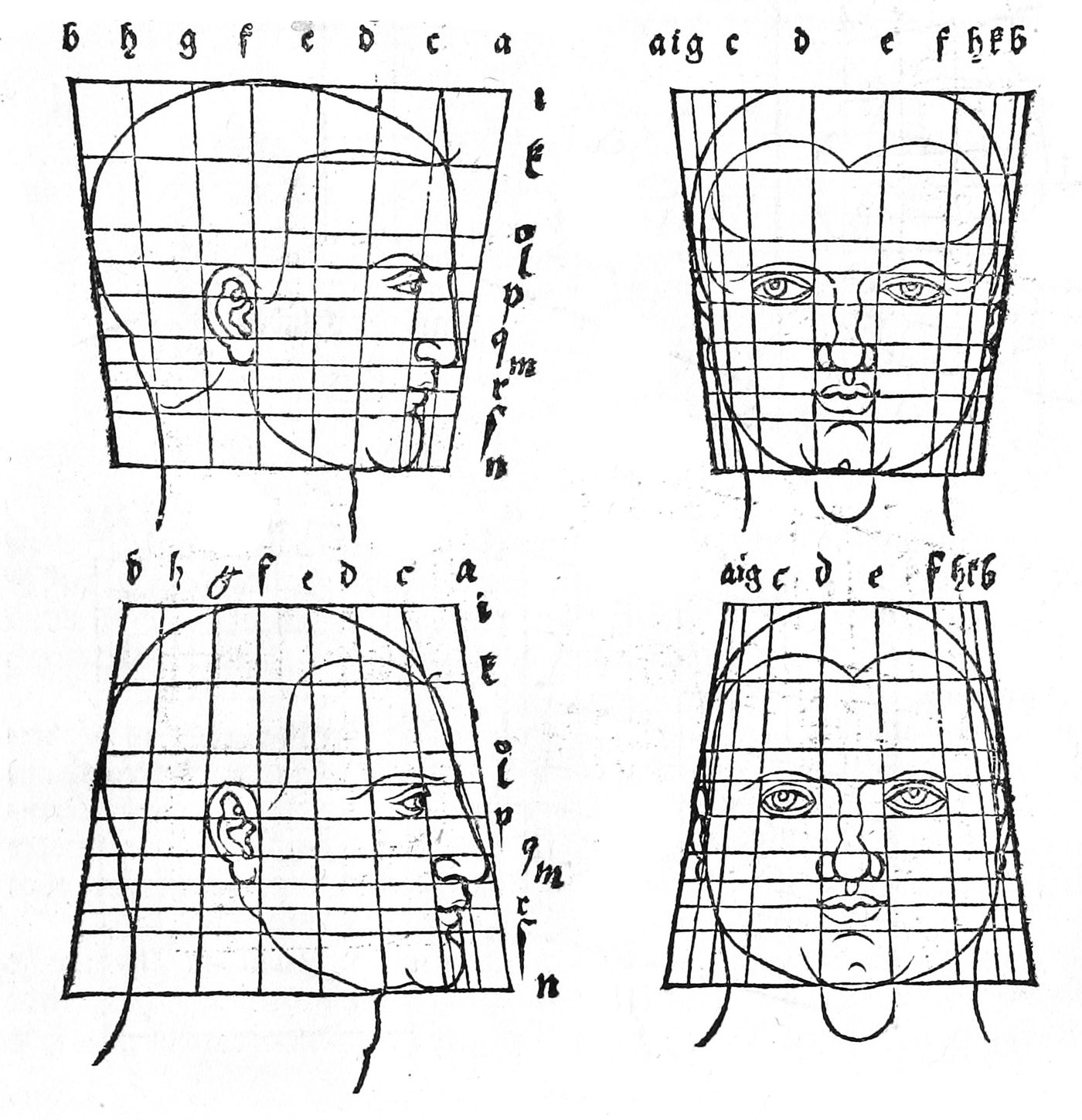
Albrecht Dürer took the proportion project somewhere genuinely new. His Vier Bücher von Menschlicher Proportion ("Four Books on Human Proportion"), published in Nuremberg in 1528, the year of his death, abandoned the search for one ideal canon entirely. 3 Instead, Dürer catalogued human variation directly: dozens of body types, ages, and — most strikingly for this history — heads constructed through stereometric transformation, where a "normal" head shape is systematically stretched, compressed, and skewed along different axes to generate a whole family of related but distinct faces. Dürer's method treated the face as a set of measurable, transformable parameters rather than a single target to be approached. It is, in a real sense, an early proportional-variation study rather than a beauty formula — closer in spirit to a morphospace than to a canon of ideal ratios.
The golden ratio as modern retrojection
The idea that a single number — the golden ratio, φ ≈ 1.618 — secretly governs beauty across Greek sculpture, Renaissance painting, and the human face is much younger than the art it claims to explain. The pivotal figure is Adolf Zeising, a nineteenth-century German psychologist whose 1854 book Neue Lehre von den Proportionen des menschlichen Körpers ("New Theory of the Proportions of the Human Body") argued that the golden ratio was a universal law of nature and art, expressed everywhere from plant growth to human anatomy to musical harmony. 4 Zeising did not discover this ratio in the ancient sources — Polykleitos's symmetria was about commensurability generally, not φ specifically — he retrofitted it onto them. The label "golden ratio" itself, and especially the Greek-letter symbol φ, is even later: the American mathematician Mark Barr proposed using φ (after the sculptor Phidias) for this constant only in 1909, more than two thousand years after Polykleitos. The mathematical constant is ancient and real; the claim that it is history's secret aesthetic law was manufactured in the nineteenth century and given its now-familiar name in the twentieth.
The most thorough dismantling of the golden-ratio-as-beauty claim came from mathematician George Markowsky, whose 1992 paper "Misconceptions about the Golden Ratio" went through the standard claims — that the Parthenon, the Great Pyramid, and da Vinci's paintings all encode φ — and showed that most of them do not survive careful measurement, and that the ones that come close do so only with generous rounding and selective measuring. 5 Markowsky's point was not that φ is uninteresting mathematically — it has genuinely elegant properties — but that its supposed reign over aesthetics is a retrojected myth, a number found first and a history built around it afterward. The throughline from Egyptian grids to Polykleitos to Dürer is a real history of proportion systems; the golden ratio's starring role in that history is a much later addition, invented to give an old story a tidier ending than it actually has.
The golden-ratio myth found its most durable modern home not in architecture but in medicine. In the 1990s the oral and maxillofacial surgeon Stephen Marquardt built and patented a golden-ratio "ideal face" template, the Golden Decagon Mask, promoted as an objective standard of facial beauty. A 2008 peer-reviewed analysis found the mask actually fits one narrow type — masculinized white fashion models — and describes sub-Saharan African, East Asian, and ordinary non-masculinized European faces poorly: 6 Zeising's universalizing mistake, relocated from the natural world to the surgeon's consultation room.
Further reading
References
- (1994). Proportion and Style in Ancient Egyptian Art. Austin: University of Texas Press. ↩
- (n.d.). Collection record, Doryphoros (Spear Bearer), Roman marble copy after Polykleitos, documenting the carved marble support strut absent from the lost bronze original. ↩
- (1528). Hierinn sind begriffen vier Bücher von menschlicher Proportion. Nuremberg: Hieronymus Andreae Formschneider. ↩
- (1854). Neue Lehre von den Proportionen des menschlichen Körpers. Leipzig: R. Weigel. ↩
- (1992). Misconceptions about the golden ratio. The College Mathematics Journal, 23(1), 2–19. ↩
- (2008). Marquardt’s Phi Mask: Pitfalls of Relying on Fashion Models and the Golden Ratio to Describe a Beautiful Face. Aesthetic Plastic Surgery, 32(2), 200–208. ↩